
Integrating Stamping, Die Casting, and Machining in Your Motor Component Supply Chain


What an integrated manufacturing supplier actually does
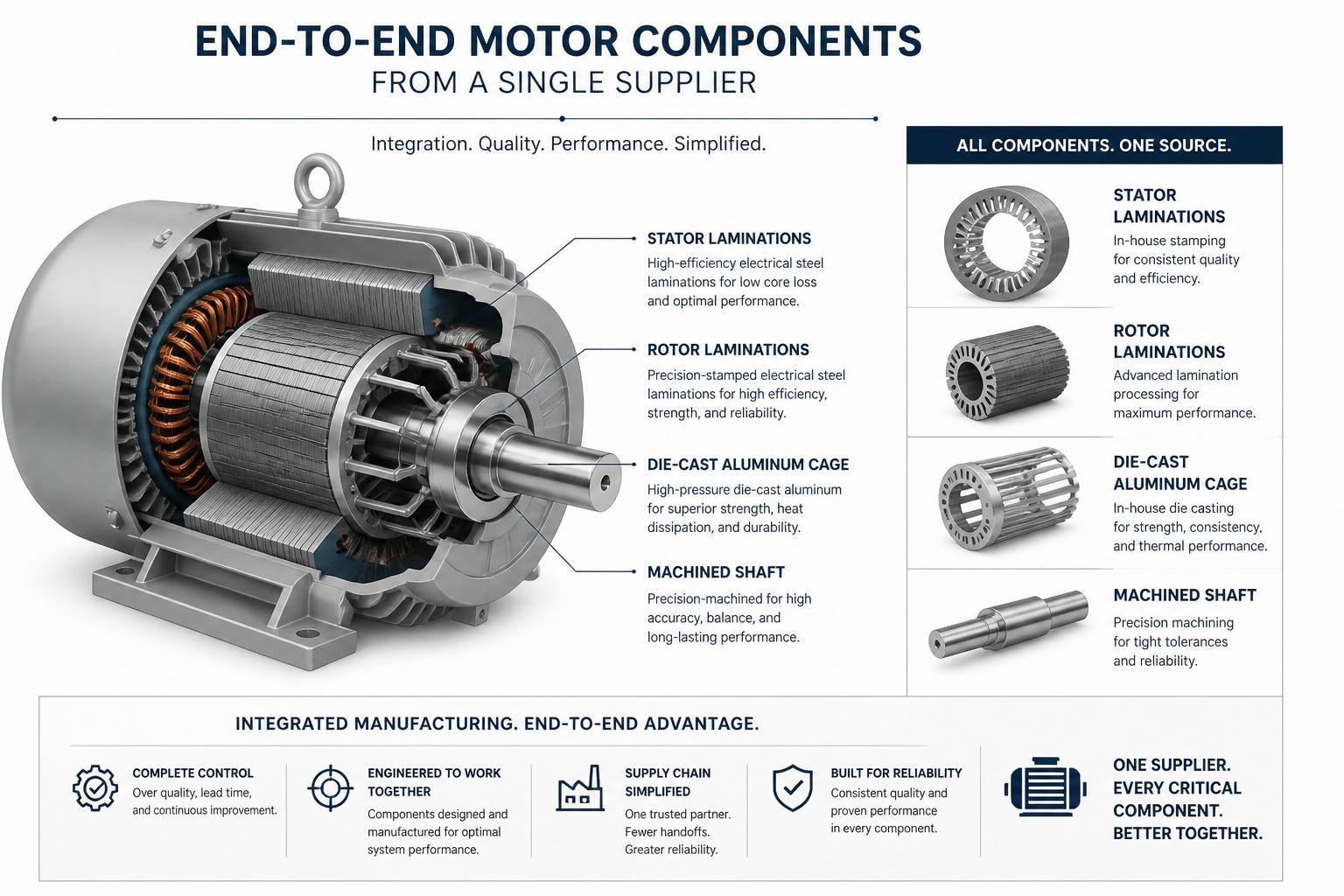
In the context of electric motor and appliance programs, an integrated manufacturing supplier is not just a trader bundling services. It is a manufacturer that directly controls key processes such as:
-
Electrical stamping (stator and rotor laminations, magnetic cores, sheet metal components)
-
Aluminium die casting for rotors and housings
-
CNC turning services and related machining of shafts, end shields, and precision features
-
Heat treatment and annealing of laminations
-
In-house tooling design, build, and maintenance for stamping and die casting
-
Testing and validation (e.g., Epstein testing for laminations, surge testing for die-cast rotors)
Instead of managing four or five suppliers, you manage one partner that delivers end to end motor components or sub-assemblies—such as a fully validated rotor assembly ready for your winding or final line.
Why OEMs are moving away from fragmented sourcing
Historically, OEMs sourced laminations, die-cast rotors, machined shafts, and sheet metal parts from different vendors to chase the lowest piece price. But this fragmented model hides cost and risk in the gaps between suppliers.
Typical pain points include:
-
Finger-pointing on quality issues when failures occur at assembly or in the field
-
Long investigation cycles because samples and data must be collected from multiple vendors
-
Unstable lead times as delays in one process cascade across the chain
-
Higher inventory buffers to protect production from upstream variability
-
Engineering change friction when every small design tweak requires aligning several suppliers
Studies on supply chain resilience from organizations like McKinsey and PwC consistently show that reducing supplier complexity and improving end-to-end visibility are key levers for resilience and cost control. Integrated manufacturing directly supports both.
Key advantages of integrating stamping, die casting, and machining
1. Lower total landed cost, not just lower piece price
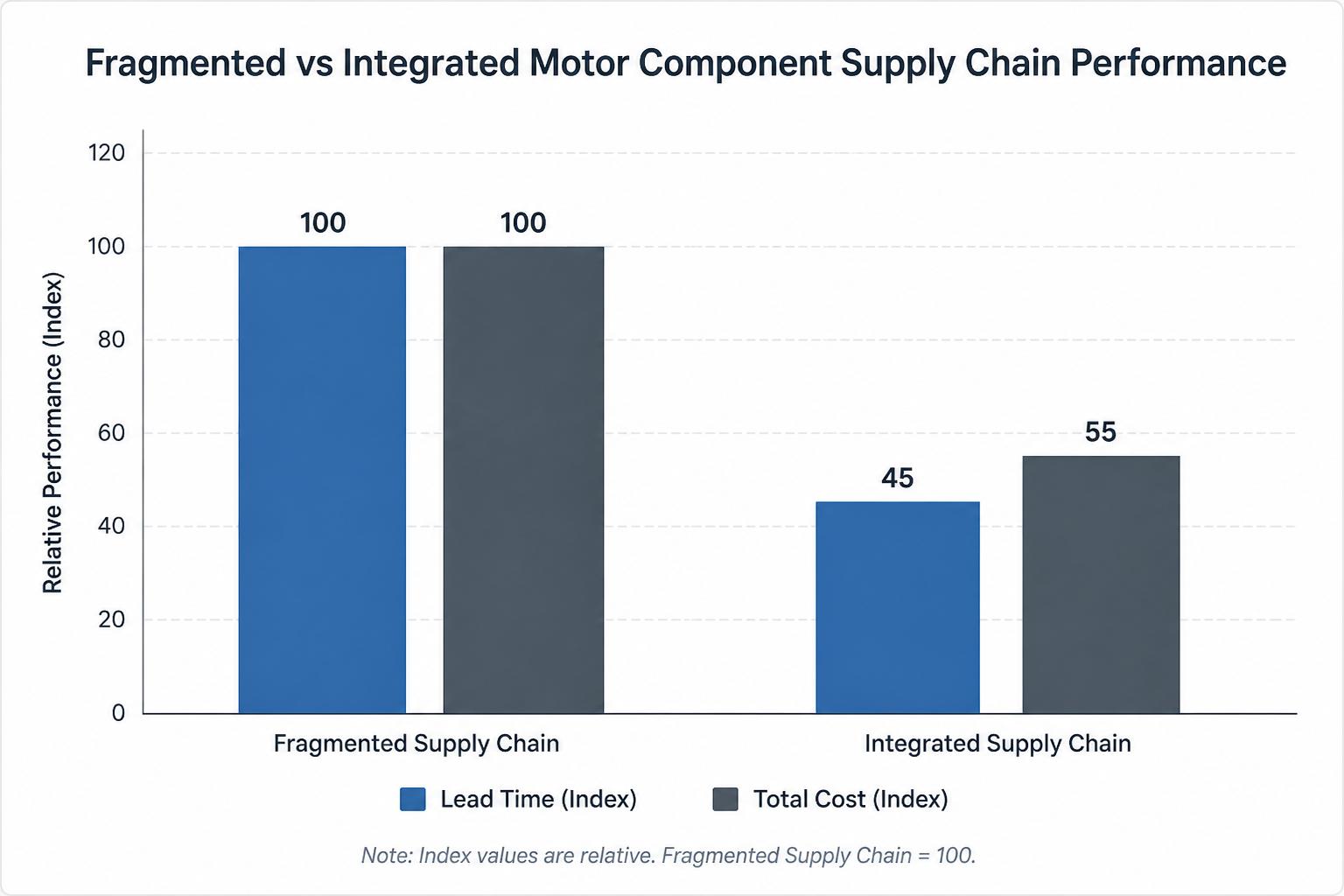
When you consolidate stamping and die casting—and add CNC turning services and testing—with one supplier, you unlock savings across the full cost picture:
-
Fewer logistics legs: Raw material to stamping to casting to machining often moves within one campus instead of across cities or countries.
-
Lower inventory carrying cost: Shorter and more predictable lead times allow leaner safety stocks.
-
Reduced quality cost: One owner for dimensional, metallurgical, and electrical performance reduces rework and scrap.
-
Shared tooling amortization: Combined volumes across similar parts can optimize tooling design and maintenance.
In many OEM programs, the visible piece price is only 60–70% of the true landed cost once you factor in logistics, quality incidents, and line stoppages. Integrated supply can materially reduce the remaining 30–40%.
2. Faster development cycles and PPAP
With an integrated manufacturing supplier, design and process engineers work together from the start:
-
Tooling for stamping and die casting is co-designed to balance performance, manufacturability, and cost.
-
Machining allowances are built into cast and stamped features to minimize cycle time and scrap.
-
Testing plans (Epstein, surge, dimensional, CMM) are aligned with your performance specs before SOP.
This integration can remove multiple loops of back-and-forth sampling. For example, in our guide on tooling design for stamping and die casting, we show how early collaboration between OEM and tooling engineers can reduce tooling iterations and accelerate PPAP by weeks.
3. Better functional performance of electric motor components
When one supplier is responsible for the full chain—from lamination stamping and annealing through die-cast rotor manufacturing to machining and testing—they can optimize the interactions between processes.
-
Magnetic performance: Lamination stamping, stacking, and annealing are tuned together to minimize core loss and meet your efficiency targets.
-
Rotor integrity: Die casting parameters, alloy choice, and surge testing are aligned to avoid porosity and bar breakage in high-speed or high-torque applications.
-
Runout and balance: Machining and CNC turning operations are referenced to stamped and cast features to control concentricity and vibration.
You can see how this plays out specifically for rotors in our overview of aluminium die casting for electric motor rotors and housings, where casting, tooling, and quality controls must work as a system.
4. Simplified quality ownership and traceability
One of the strongest arguments for an integrated manufacturing supplier is single-point quality ownership.
-
Unified control plans cover stamping, die casting, machining, and testing under one ISO-certified QMS.
-
End-to-end traceability links heat numbers, coil batches, die-cast lots, and machining operations to final test results.
-
Faster root cause analysis because the same team owns both process data and test data.
Our deep dive into die casting quality controls explains how combining visual, dimensional, and electrical checks (including surge testing) under one roof improves reliability and reduces field failures.
5. Lower supply chain risk
Global disruptions, raw material volatility, and logistics bottlenecks have made resilient supply chains a board-level topic. Integrated manufacturing supports resilience by:
-
Reducing supplier count, which simplifies risk monitoring and contingency planning
-
Enabling dual-plant strategies within the same supplier group instead of re-qualifying multiple vendors
-
Improving visibility across the complete value stream, from steel coil to tested rotor
Research from the World Economic Forum on global risks underscores the importance of supply chain robustness; integrated, regionally based manufacturing is one of the most practical levers OEMs can pull.
How integration works across the motor component value chain
1. Electrical stamping and lamination manufacturing
An integrated supplier like ASA Industries begins with high-precision motor stamping and lamination manufacturing:
-
Progressive die stamping for stator and rotor laminations across single-phase induction, BLDC, universal, and shaded pole motors
-
Tooling design and maintenance in-house to ensure accuracy and uptime
-
Annealing and Epstein testing to validate magnetic performance of cores
Design decisions at this stage (slot geometry, lamination stack height, material grade) strongly influence rotor behavior, losses, and noise. Integration ensures these choices are made with downstream casting and machining in mind.
2. Aluminium die casting of rotors and housings
Next, lamination stacks move directly to aluminium die casting cells, where rotors and, in some programs, motor housings are cast.
-
Die design considers lamination stack tolerances, shrinkage, and machining allowances.
-
Process parameters are tuned to avoid porosity and ensure good bar and end-ring fill.
-
In-process quality checks and surge testing validate electrical continuity and rotor robustness.
Because stamping and die casting are integrated, issues like lamination burrs or stack misalignment can be addressed quickly without cross-company negotiations.
3. CNC turning and precision machining
From casting, rotors and related components move into CNC turning services and machining cells:
-
Turning of shafts, journals, and bearing seats to tight concentricity and runout requirements
-
Machining of housings, end shields, and mounting features for appliance or automotive interfaces
-
Secondary operations such as drilling, tapping, and keyway cutting
Because the machining team is part of the same organization that owns stamping and die casting, they can provide feedback on tooling, gating, or lamination tolerances that impact cycle time or scrap—and implement changes quickly.
4. Testing, validation, and packaging to line-ready condition
The final stage is integrated testing and packaging of electrical motor components or sub-assemblies:
-
Dimensional inspection (SPC, CMM) against critical-to-quality features
-
Electrical testing such as Epstein for cores and surge testing for rotors
-
Visual inspection and surface checks for cosmetic and functional defects
-
Packaging designed to feed your assembly line with minimal handling and damage risk
The result is a single, validated part number or kit arriving at your plant—rather than multiple parts that must be combined and checked on your line.
What to look for in an integrated manufacturing supplier
Not every supplier that claims “end-to-end” capability actually controls the critical processes in-house. When evaluating partners, OEMs should look for:
1. Real in-house capability across core processes
-
High-tonnage presses for electrical stamping and progressive die operations
-
Die casting machines sized appropriately for your rotor and housing range
-
CNC turning and machining centers with the accuracy and throughput your program requires
-
Tooling design, manufacturing, and maintenance under the same roof
-
Dedicated testing setups (Epstein, surge, etc.) aligned with your specifications
2. Proven quality systems and controls
For safety- and performance-critical components like motor rotors and stators, quality systems matter as much as machines.
-
ISO-certified quality management with documented control plans for each process
-
SPC on key dimensions and characteristics, not just end-of-line inspection
-
Clear traceability from raw material to final test results
-
Documented approaches to surge testing, Epstein testing, and other special checks
Independent standards bodies such as ISO 9001 provide a baseline, but you should also audit how the supplier applies these standards to stamping and die casting specifically.
3. Engineering depth and DFM support
An integrated supplier should be able to support you from concept through SOP, not just run parts to print.
-
Design-for-manufacturing (DFM) input on lamination geometry, stack design, and slot configuration
-
Recommendations on rotor bar design, alloy selection, and die cooling for performance and life
-
Machining and assembly considerations that reduce cycle time on your line
-
Joint problem-solving on noise, vibration, and efficiency issues observed in testing
4. Capacity, scalability, and delivery performance
Finally, the supplier must be able to scale with your program and deliver consistently.
-
Installed capacity and expansion plans aligned with your volume roadmap
-
On-time delivery metrics and logistics capabilities for your regions
-
Experience serving multiple OEMs in appliances, HVAC, automotive, or industrial sectors
How ASA Industries approaches integrated manufacturing for motor components
ASA Industries has built its model around being a long-term, single source supplier for electric motor and appliance OEMs that want to simplify their supply chain while improving technical performance.
Key elements of ASA’s integrated offering include:
-
Electrical stamping and laminations for stators and rotors across single-phase induction, BLDC, universal, and shaded pole motors
-
Aluminium die casting with 80–250 Ton locking capacity for rotors and selected housings
-
CNC turning services and precision machining for shafts, housings, and related components
-
In-house tooling design, manufacturing, and maintenance for both stamping and die casting
-
Annealing, Epstein testing, and surge testing to ensure electrical and mechanical reliability
-
ISO-certified quality systems, SPC, and robust incoming and final inspection
An integrated manufacturing supplier should not just combine processes—it should combine accountability, engineering insight, and data across the full value chain.
